How to Save ₹1 Lakh in One Year: A Simple Monthly Savings Plan
Saving ₹1 lakh in one year may sound difficult, especially if you have a limited salary or many monthly expenses. However, the goal becomes much easier when you break it down into smaller monthly and weekly targets.
You don’t necessarily need a very high income to save ₹1 lakh. What matters most is having a clear plan, controlling unnecessary expenses, and consistently setting aside money throughout the year.
If your goal is to save ₹1,00,000 in 12 months, here’s how you can create a practical savings plan.
How Much Do You Need to Save Each Month?
The simplest calculation is:
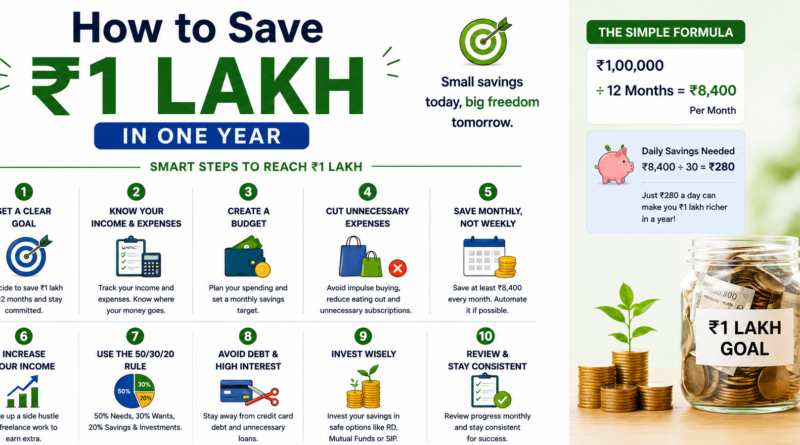
₹1,00,000 ÷ 12 months = approximately ₹8,334 per month
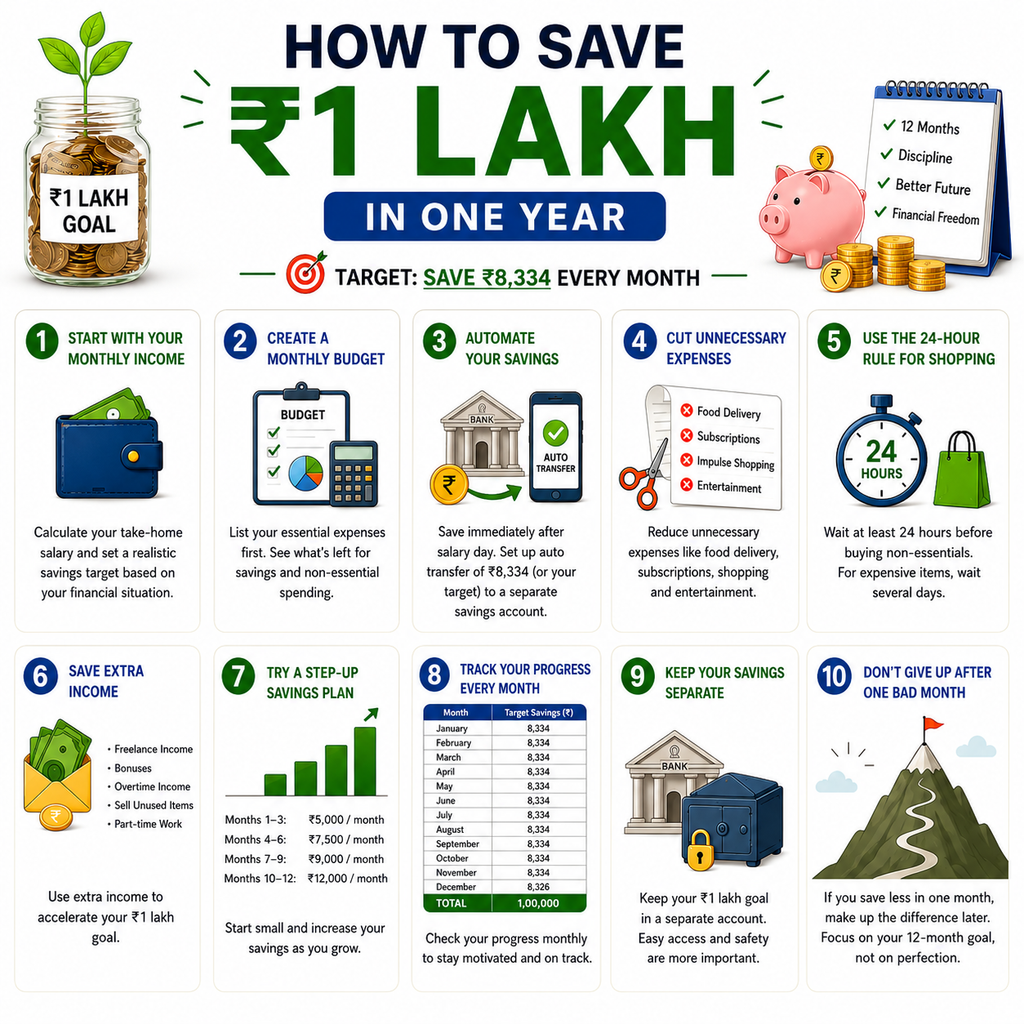
So, you need to save around ₹8,334 every month to reach ₹1 lakh in one year, assuming you are not counting investment returns.
You can also think about the target weekly. It works out to roughly ₹1,923 per week.
Don’t worry if ₹8,334 per month seems too high. You can combine regular savings with expense reductions and additional income.
1. Start With Your Monthly Income
Before creating your savings plan, calculate your take-home salary.
For example, suppose your monthly income is ₹30,000. Saving ₹8,334 would represent a significant portion of your income, so you would need to carefully manage your expenses.
If your income is ₹50,000, the target may be more manageable.
The important thing is to create a target based on your actual financial situation rather than copying someone else’s budget.
2. Create a Monthly Budget
Write down your essential expenses first.
These may include:
- Rent
- Groceries
- Electricity
- Transportation
- Mobile and internet bills
- Essential loan payments
- Insurance
- Other necessary expenses
After calculating your essential costs, determine how much remains for savings and non-essential spending.
A budget helps you identify where your money is going and where you can make changes.
3. Automate Your Savings
One of the easiest ways to stay consistent is to save immediately after receiving your salary.
For example, if your salary arrives on the first day of the month, automatically transfer a fixed amount into a separate savings account.
If your target is ₹8,334, you could set aside approximately that amount every month.
By automating the process, you reduce the temptation to spend the money first.
4. Cut Unnecessary Expenses
Look for expenses that you can reduce without affecting your essential needs.
For example:
- Reduce food delivery
- Limit restaurant visits
- Cancel unused subscriptions
- Avoid impulse shopping
- Compare prices before buying
- Reduce unnecessary entertainment spending
- Plan grocery purchases
Suppose you reduce your unnecessary expenses by ₹3,000 per month. That’s ₹36,000 in potential savings over one year.
5. Use the 24-Hour Rule for Shopping
Impulse purchases can make it difficult to reach a savings goal.
Before buying something that isn’t essential, wait at least 24 hours.
For expensive purchases, consider waiting several days.
This simple habit gives you time to decide whether you genuinely need the item or simply want it at that moment.
6. Save Extra Income
You don’t have to reach ₹1 lakh only through your monthly salary.
If you receive additional income during the year, consider putting some or all of it toward your savings goal.
Examples include:
- Freelance income
- Bonuses
- Overtime income
- Selling unused items
- Temporary part-time work
- Other legitimate additional income
Even ₹10,000–₹20,000 of additional savings can significantly reduce the amount you need to save from your regular salary.
7. Try a Step-Up Savings Plan
If saving ₹8,334 every month isn’t possible initially, start with a smaller amount and gradually increase it.
For example:
Months 1–3: ₹5,000 per month
Months 4–6: ₹7,500 per month
Months 7–9: ₹9,000 per month
Months 10–12: ₹12,000 per month
You can adjust these numbers according to your income and expenses.
The key idea is to increase your savings when your financial situation allows it.
8. Track Your Progress Every Month
Create a simple savings tracker.
For example:
| Month | Target Savings |
|---|---|
| January | ₹8,334 |
| February | ₹8,334 |
| March | ₹8,334 |
| April | ₹8,334 |
| May | ₹8,334 |
| June | ₹8,334 |
| July | ₹8,334 |
| August | ₹8,334 |
| September | ₹8,334 |
| October | ₹8,334 |
| November | ₹8,334 |
| December | ₹8,326 |
| Total | ₹1,00,000 |
Checking your progress every month can keep you motivated and help you identify problems early.
9. Keep Your Savings Separate
Consider keeping the money for your ₹1 lakh goal separate from your everyday spending account.
This makes it easier to see your progress and reduces the chance of accidentally spending the money.
If this money is also intended to serve as an emergency fund, prioritize safety and easy access rather than taking unnecessary investment risks.
10. Don’t Give Up After One Bad Month
Unexpected expenses can happen.
You might have a month when you cannot save the planned amount. That doesn’t mean your goal has failed.
For example, if you save only ₹5,000 one month instead of ₹8,334, you have a shortfall of ₹3,334. You can gradually make up the difference over the following months if your budget allows.
Focus on the full 12-month goal rather than expecting every month to be perfect.
Conclusion
Saving ₹1 lakh in one year is challenging, but it becomes much more achievable when you turn the large goal into smaller targets.
A target of approximately ₹8,334 per month gives you a straightforward starting point. Create a realistic budget, automate your savings, reduce unnecessary expenses, avoid impulse purchases, and use additional income to accelerate your progress.
Most importantly, start with the amount you can realistically afford and increase your savings whenever your income improves.
₹1 lakh may look like a big number, but consistent monthly saving can turn a large financial goal into a manageable one.