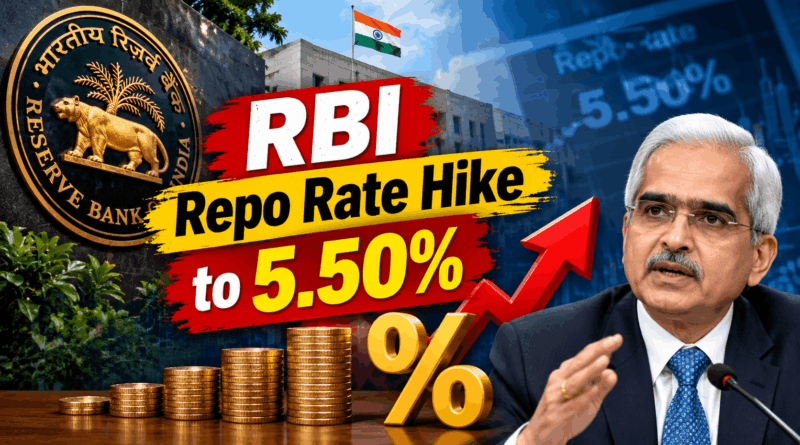
RBI Repo Rate Hike to 5.50%
Impact on Loans and EMIs
The Reserve Bank of India (RBI) has increased the repo rate by 25 basis points, taking it from 5.25% to 5.50% on October 7, 2026. This is the first repo rate hike since February 2023 and marks an important shift in the central bank’s monetary policy approach. The RBI’s Monetary Policy Committee (MPC) unanimously supported the increase and changed its policy stance from “neutral” to “calibrated tightening.”
The decision is important for millions of Indian borrowers because changes in the repo rate can influence lending rates, particularly for loans linked to external benchmarks. Home-loan, auto-loan and some other floating-rate borrowers could see higher interest costs after their lenders transmit the increase.
Why Did RBI Increase the Repo Rate?

The RBI’s decision comes at a time when inflationary pressures have become more visible. Rising crude oil prices, food and energy costs and uncertainty in the global economy have increased concerns about inflation.
At the same time, India’s economy continues to show strong growth. The RBI raised its FY27 GDP growth projection from 6.7% to 7.1%, while inflation expectations were also revised upward. The rate hike is therefore aimed at maintaining price stability while managing strong domestic economic activity.
What Is the Repo Rate?
The repo rate is the interest rate at which the RBI lends short-term funds to commercial banks. When the repo rate rises, borrowing money from the central bank becomes more expensive for banks.
Banks can then pass some of this increased funding cost to customers by raising lending rates. The effect is particularly relevant for borrowers whose loans are linked to an external benchmark such as the repo rate.
Impact on Home Loan EMIs
Home-loan borrowers with floating interest rates are likely to feel the biggest impact.
For example, if a bank passes the full 25-basis-point increase to a repo-linked loan, the borrower could face either:
- A higher monthly EMI
- A longer loan repayment tenure
- Or a combination of both
The exact impact depends on the outstanding principal, remaining tenure, current interest rate and the lender’s reset mechanism. A higher EMI is not automatic on the same day for every borrower. Banks may adjust rates according to the reset terms of the loan agreement.
For example, a recent calculation for a ₹50 lakh home loan over 25 years showed that an interest-rate increase from 7.50% to 7.75% could raise the monthly EMI from roughly ₹36,950 to ₹37,766. This is only an illustration; actual EMIs depend on the lender and individual loan terms.
What About Personal Loans?
Personal-loan borrowers should also watch for changes, although the transmission mechanism differs between lenders and loan products.
Many personal loans are priced differently from repo-linked home loans, and some may have fixed or other benchmark structures. Therefore, a 25-basis-point RBI hike does not automatically mean every personal-loan EMI will rise by exactly 25 basis points.
Existing borrowers should check their loan agreement and ask the lender whether their interest rate is floating, what benchmark it uses and when the next reset will occur.
Impact on Car and Auto Loans
Floating-rate vehicle loans can also become more expensive when lenders pass on the increase.
New car buyers may face slightly higher borrowing costs if banks and financial institutions revise their lending rates. Existing borrowers may also see changes depending on their loan structure and reset terms.
However, borrowers should not assume that every car-loan EMI will immediately increase. The actual effect depends on the lender, benchmark and repayment agreement.
Will Fixed-Rate Loan Borrowers Be Affected?
Borrowers with genuinely fixed-rate loans are generally more protected from immediate changes in market interest rates because their contracted rate remains fixed for the applicable period.
MCLR-linked borrowers may experience slower transmission compared with loans directly linked to external benchmarks. Therefore, borrowers should identify whether their loan is repo-linked, EBLR-linked, MCLR-linked or fixed-rate before estimating the impact.
What Should Borrowers Do Now?
Borrowers do not necessarily need to panic after the 25-basis-point increase. However, they should review their finances carefully.
1. Check Your Loan Interest Rate
Look at your latest loan statement and identify the benchmark, current interest rate and reset date.
2. Ask the Bank About the New EMI
If you have a floating-rate loan, contact your lender and ask whether the 25-basis-point increase will be passed on to you.
3. Consider Part-Prepayment
Borrowers with sufficient surplus funds may consider part-prepayment to reduce the outstanding principal. However, check applicable charges and terms before making a decision.
4. Avoid Taking Unnecessary New Debt
With borrowing costs potentially moving higher, consumers should be cautious about taking additional loans for non-essential expenses.
5. Keep an Emergency Fund
Maintaining an emergency fund becomes particularly important when monthly financial commitments can increase.
Could FD Rates Also Rise?
A repo-rate increase can also influence deposit rates. Banks may eventually offer better rates on some fixed deposits and other savings products as competition for deposits changes.
This means the impact is not necessarily negative for everyone. While borrowers may face higher costs, savers could potentially benefit from improved deposit returns, depending on how banks respond.
Final Verdict
The RBI’s decision to raise the repo rate to 5.50% is significant because it marks the first rate hike since February 2023 and signals a shift toward tighter monetary policy.
For borrowers, the immediate concern is the possibility of higher EMIs or longer repayment periods, particularly for floating-rate loans linked to external benchmarks. Home-loan borrowers are likely to watch the decision most closely, while auto and personal-loan customers should check their individual loan terms.
The actual impact will vary from borrower to borrower. Consumers should therefore check their interest rate, benchmark and reset date rather than assuming that every EMI will rise by the same amount.
In short, the 25-basis-point hike may look small, but over a long loan tenure even a modest increase in interest costs can affect household budgets. Borrowers should review their loans now and plan their finances accordingly.
Key Highlights:
- New RBI Repo Rate: 5.50%
- Increase: 25 basis points
- Previous Rate: 5.25%
- First hike since: February 2023
- Policy stance: Calibrated tightening
- FY27 GDP growth forecast: 7.1%
- Main impact: Potentially higher borrowing costs for floating-rate loans
This article is for general information only and should not be considered personal financial advice.