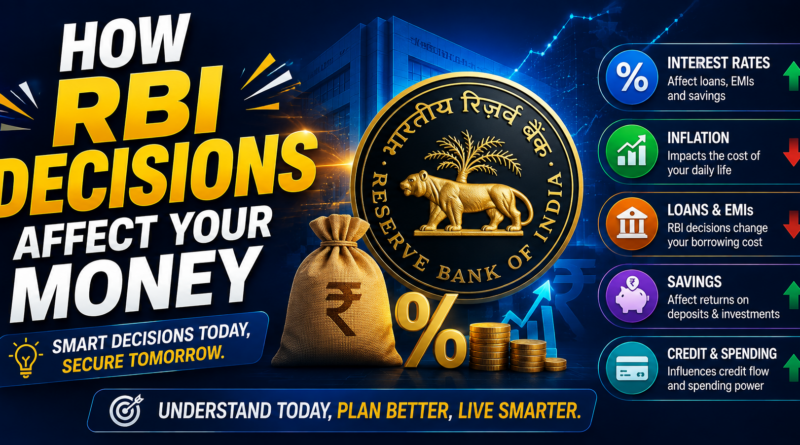
How RBI Decisions Affect Your Money: Loans, Savings, Investments and Everyday Expenses
The Reserve Bank of India (RBI) plays an important role in India’s economy. Even if you don’t follow financial news or the stock market, RBI decisions can affect your everyday finances.
When the RBI changes interest rates or takes steps to manage liquidity and inflation, the impact can eventually reach bank loans, fixed deposits, savings, investments, businesses and even household expenses.
Understanding how RBI decisions affect your money can help you make better financial decisions.
What Is the RBI?
The Reserve Bank of India is India’s central bank. One of its important responsibilities is managing monetary policy.
The RBI uses monetary-policy tools to influence borrowing conditions, liquidity and inflation while supporting economic stability.
One of the most closely watched rates is the repo rate. It influences the broader interest-rate environment and can affect the rates banks charge on loans and offer on deposits.
The RBI’s Monetary Policy Committee (MPC) reviews monetary policy regularly and decides whether rates should be increased, reduced or maintained.
How a Repo Rate Cut Can Affect You
When the RBI reduces the repo rate, borrowing conditions can become easier.
Banks may eventually reduce certain lending rates, depending on their funding costs and how quickly the policy change passes through to customers.
This can benefit people who have loans linked to external benchmarks.
Home Loans
A lower interest-rate environment can reduce borrowing costs for some floating-rate home-loan customers.
For example, if your loan interest rate falls, you may either pay a lower monthly EMI or potentially shorten the loan tenure while maintaining a similar EMI.
However, the actual impact depends on your lender, loan type, benchmark and the terms of your loan.
Personal Loans and Other Borrowing
Changes in the interest-rate environment can also influence personal loans, vehicle loans and business loans.
Lower borrowing costs may encourage consumers and businesses to borrow more.
However, borrowers should not take a new loan simply because interest rates are lower.
Before borrowing, consider the total interest cost, processing fees, repayment period and whether the EMI fits comfortably within your budget.
How an RBI Rate Hike Can Affect Borrowers
The opposite can happen when the RBI increases rates.
Higher rates can make borrowing more expensive.
For borrowers with floating-rate loans, an increase in the applicable lending rate can result in a higher EMI, a longer repayment period, or both, depending on the lender’s method of adjustment.
This is why people with large home loans should pay attention to changes in interest rates.
A small change in an interest rate can have a meaningful effect when applied to a large loan over many years.
What Happens to Fixed Deposits?
RBI decisions can also affect savers.
When interest rates rise, banks may offer more attractive rates on some new fixed deposits and other deposits.
When rates fall, deposit rates may eventually decline as banks adjust their pricing.
The effect isn’t always immediate or identical across banks.
This means depositors should compare current rates, tenure, premature-withdrawal rules, taxation and the overall safety of the institution rather than choosing an FD based only on the headline interest rate.
What About Savings Accounts?
Savings-account interest rates can also be influenced by broader market conditions, although the relationship isn’t always one-to-one.
If you keep a significant amount of money in a savings account, it’s worth checking whether the account is providing an appropriate return for your needs.
For short-term emergency savings, however, accessibility and safety can be more important than chasing a slightly higher rate.
RBI Decisions and Inflation
One of the major reasons the RBI changes monetary policy is to manage inflation while supporting economic growth.
When inflation becomes a concern, tighter monetary conditions can help moderate demand and price pressures.
When inflation is under control and economic growth needs support, the RBI may have more room to consider easier monetary conditions.
For ordinary households, inflation matters because it determines how much everyday goods and services cost.
If prices rise faster than your income or savings return, your purchasing power can decline.
How RBI Decisions Affect the Share Market
RBI decisions can also influence the stock market.
When interest rates fall, borrowing may become cheaper for companies. Lower financing costs can potentially support business investment and profits.
Lower interest rates can also influence investor preferences because returns available from fixed-income products may change.
On the other hand, higher interest rates can increase borrowing costs for companies and consumers.
However, the stock market doesn’t respond only to RBI decisions. Global markets, company earnings, crude-oil prices, inflation, foreign investment, geopolitical events and investor sentiment can also move stock prices.
Therefore, investors should not buy or sell stocks based solely on an RBI announcement.
How RBI Decisions Affect the Rupee
Interest-rate changes can also influence currency markets.
Interest-rate expectations in India compared with other countries can affect capital flows and investor demand for Indian assets.
The rupee, however, is influenced by many factors, including crude-oil prices, global interest rates, trade flows, foreign investment and overall market sentiment.
Therefore, an RBI decision is only one part of the bigger currency picture.
RBI Decisions and Gold
Gold prices can also be influenced indirectly by interest-rate expectations.
When interest rates and bond yields are attractive, some investors may prefer interest-bearing assets.
When uncertainty rises or investors expect lower real returns from traditional assets, demand for gold can sometimes increase.
However, gold prices are also heavily influenced by international prices, the US dollar, global economic conditions and geopolitical risks.
Gold should therefore not be treated as a guaranteed beneficiary of every RBI decision.
What Should You Do When the RBI Announces a Policy Decision?
You don’t need to make a major financial decision every time the RBI announces its policy.
Instead, use the announcement as an opportunity to review your finances.
If You Have a Loan
Check whether your interest rate has changed and understand how your lender will adjust the EMI or loan tenure.
If You Have Fixed Deposits
Compare current FD rates when your deposits mature rather than automatically renewing them without checking alternatives.
If You Are Investing
Avoid making investment decisions based on headlines alone. Consider your financial goals, risk tolerance and investment time horizon.
If You Are Saving
Make sure your emergency fund remains easily accessible and that your savings strategy matches your short-term and long-term needs.
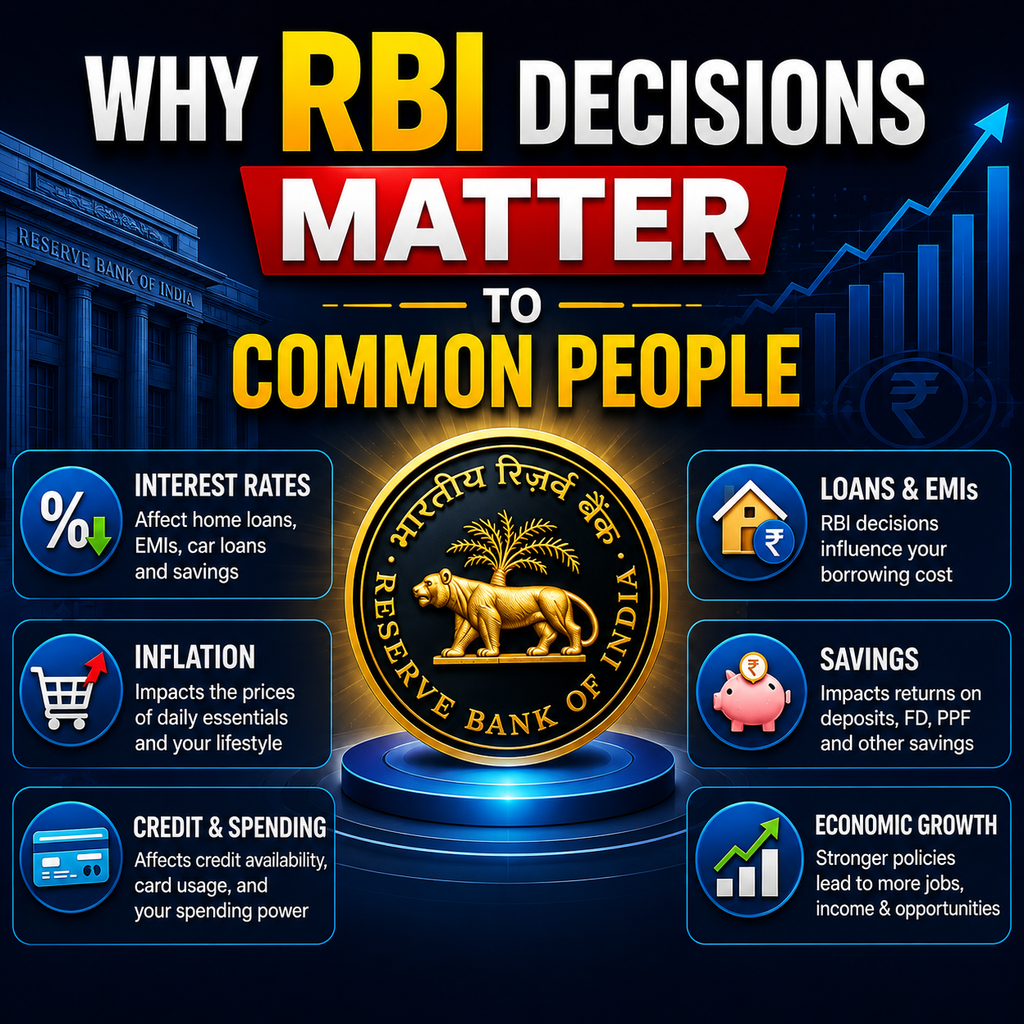
Why RBI Decisions Matter to Common People
RBI policy may sound like something that only affects economists, banks and investors, but its impact can eventually reach ordinary households.
A change in interest rates can influence:
- Home-loan EMIs
- Personal-loan costs
- Vehicle-loan costs
- Fixed-deposit returns
- Savings returns
- Business borrowing
- Investment markets
- Inflation
- Currency movements
The effect can take time to reach consumers, and different banks and financial products may respond differently.
Conclusion
RBI decisions can have a significant impact on your personal finances, even when you don’t directly interact with the central bank.
A repo-rate change can influence borrowing costs, deposit rates and the broader financial environment. RBI policy can also affect inflation, investment markets and economic activity.
For borrowers, it is important to understand how interest-rate changes affect EMIs and total loan costs. For savers, comparing deposit rates and maintaining an appropriate emergency fund can be useful. Investors should focus on long-term financial goals rather than reacting emotionally to every RBI announcement.
The key lesson is simple:
Don’t just follow RBI decisions—understand how they could affect your loans, savings and investments.
By keeping track of interest rates, inflation and your own financial goals, you can make more informed money decisions and avoid unnecessary financial stress.