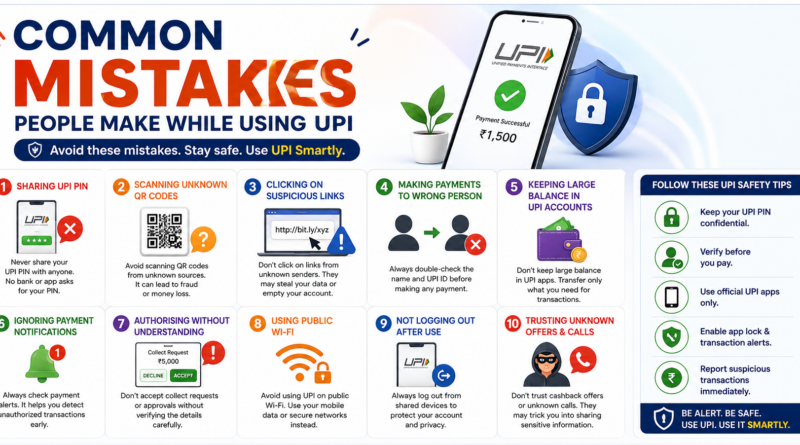
Common Mistakes People Make While Using UPI
Unified Payments Interface (UPI) has changed the way people make payments in India. From paying at local shops to sending money to friends and family, UPI allows users to transfer money quickly using a smartphone.
However, convenience can sometimes lead to careless mistakes. Many UPI-related problems happen because users do not carefully check payment details or unknowingly follow instructions from scammers.
Understanding the most common mistakes can help you use UPI more safely and avoid unnecessary financial losses.
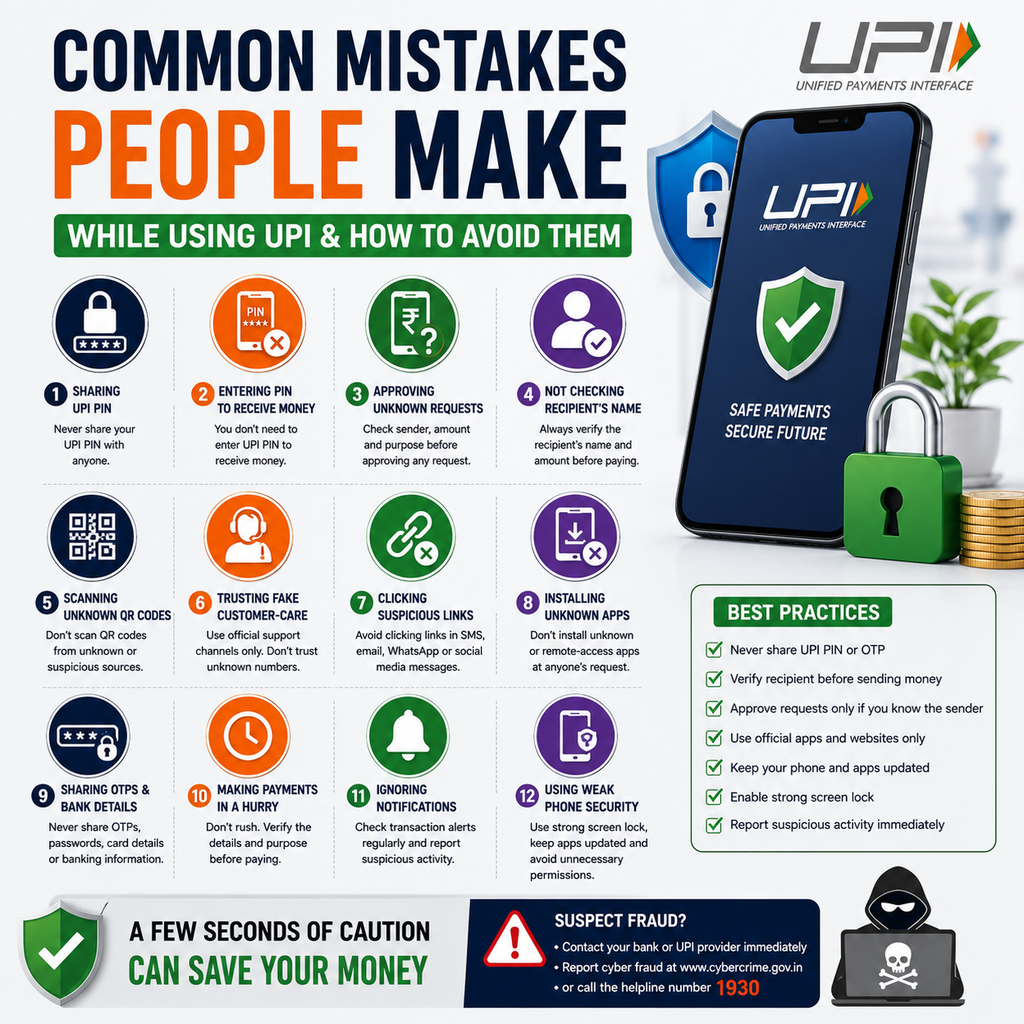
1. Sharing Your UPI PIN With Others
One of the biggest mistakes UPI users can make is sharing their UPI PIN.
Your UPI PIN is confidential and should never be shared with another person. Someone may claim to be a bank employee, customer-care representative, delivery agent, or other official and ask for your PIN.
Do not share it.
A legitimate service representative should not need your UPI PIN to help you with a normal payment-related issue.
2. Entering a UPI PIN to Receive Money
Another common mistake is believing that you need to enter your UPI PIN to receive money.
Scammers may tell you that they are sending you money and ask you to enter your PIN to “accept” or “receive” the payment.
Always read the payment screen carefully before entering your PIN. Your PIN is generally used to authorize a payment from your account, so an unexpected request to enter it should make you stop and verify what is happening.
3. Approving Unknown Collect Requests
UPI can be used for payment requests, and scammers may try to convince users to approve requests they don’t recognize.
Before approving any request, check the sender, amount, and purpose.
If you did not expect the request, don’t approve it simply because someone is calling or messaging you and asking you to do so.
4. Not Checking the Recipient’s Name
UPI payments can happen within seconds, which makes it easy to accidentally send money to the wrong person.
Before confirming a payment, carefully check the recipient details and the amount.
This is especially important when transferring money to a new UPI ID, phone number, or QR code.
Take a few seconds to verify before pressing the final payment button.
5. Scanning Unknown QR Codes
QR codes are convenient, but users should not assume that every QR code is safe.
A QR code can be used to initiate a payment. Before scanning or approving a transaction, understand what the payment request is asking you to do.
If someone unexpectedly sends you a QR code and asks you to scan it to receive money, be cautious.
6. Trusting Fake Customer-Care Numbers
People sometimes search online for customer-care numbers when they have a payment problem.
Unfortunately, scammers can publish fake phone numbers or create misleading websites and social-media profiles.
If you need help with a UPI transaction, use the support section of your official UPI or banking application or visit the official website of your bank or payment provider.
Avoid sharing sensitive information with an unknown caller.
7. Clicking Suspicious Links
Scammers may send links claiming that you need to:
- Receive a refund
- Complete a payment
- Update your account
- Verify your bank details
- Claim a reward
- Fix a UPI problem
Don’t click suspicious links simply because the message looks urgent.
Instead, open your official banking or payment application directly and check whether any action is actually required.
8. Installing Unknown Apps
Another dangerous mistake is installing an unfamiliar application because someone claims it is required to solve a payment problem.
Fraudsters may ask victims to install remote-access or screen-sharing applications.
Never install an unknown app at the request of an unexpected caller. If you need technical assistance, use official support channels.
9. Sharing OTPs and Banking Information
Your OTP, UPI PIN, passwords, card details, and other banking credentials are private.
Never share them with people who contact you unexpectedly.
Even if the caller knows your name, bank name, or transaction details, don’t assume they are genuine.
10. Making Payments in a Hurry
Scammers often create a sense of urgency.
They may say:
“Pay immediately.”
“Your account will be blocked.”
“Your refund will expire.”
“Your electricity connection will be disconnected.”
Don’t allow pressure to make you skip basic checks.
Stop, verify the request independently, and then decide whether a payment is actually necessary.
11. Ignoring Transaction Notifications
Don’t ignore SMS, app notifications, or bank alerts about transactions.
Review notifications regularly so you can identify unauthorized transactions quickly.
If you notice something suspicious, contact your bank or payment provider through an official channel as soon as possible.
12. Using Weak Phone Security
Your smartphone is closely connected to your digital-payment accounts.
Using a strong screen lock can provide an additional layer of protection if your phone is lost or stolen.
Keep your phone’s operating system and financial applications updated, and avoid giving unnecessary permissions to unfamiliar applications.
What Should You Do If You Make a UPI Mistake?
If you accidentally send money to the wrong person or suspect fraud, act quickly.
Contact your bank or UPI service provider through an official support channel and report the issue. For suspected financial cyber fraud in India, you can also report it through the official cybercrime reporting system or by calling 1930.
Keep transaction IDs, screenshots, messages, and other relevant information available when reporting the incident.
Conclusion
UPI is a fast and convenient way to make digital payments, but users should remain careful with every transaction.
The most important habits are simple: never share your UPI PIN or OTP, verify recipients before paying, don’t approve unknown requests, avoid suspicious links, and use only official customer-support channels.
Taking a few extra seconds before confirming a transaction can help protect your money and reduce the risk of falling victim to online scams.
Use UPI conveniently, but always verify before you pay.