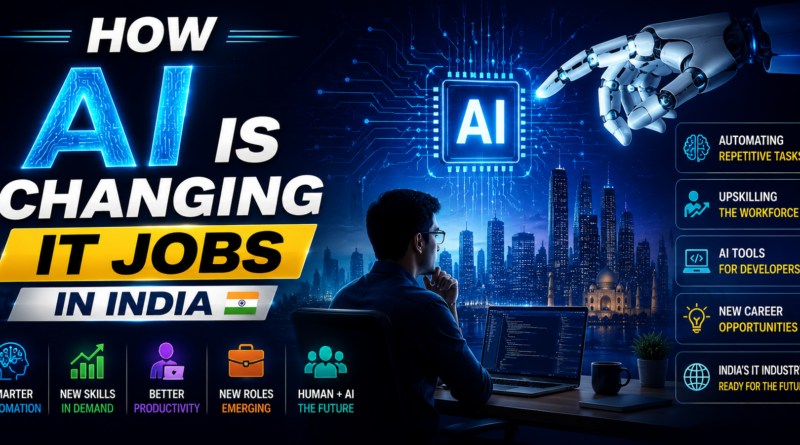
How AI Is Changing IT Jobs in India: Skills, Opportunities and the Future
Artificial intelligence (AI) is rapidly changing the technology industry in India. From software development and testing to cybersecurity, cloud computing, data analytics and customer support, AI tools are becoming part of everyday IT work.
This does not simply mean that AI will replace IT professionals. Instead, many jobs are being redesigned, with employees increasingly expected to work alongside AI tools and use them to improve productivity.
Recent industry data shows how quickly this shift is happening. LinkedIn India reported in August 2026 that AI engineering jobs in India had increased significantly, while employers were increasingly focusing on skills rather than traditional credentials.
For students, freshers and working IT professionals, understanding this change is becoming increasingly important.
AI Is Changing the Way Software Developers Work
Software developers are among the IT professionals most directly affected by AI.
AI coding assistants can help developers:
- Generate code
- Explain existing code
- Find potential errors
- Create test cases
- Write documentation
- Suggest improvements
- Automate repetitive development tasks
Instead of spending hours writing every line manually, developers can use AI for repetitive tasks and spend more time on architecture, problem-solving, testing and business requirements.
However, developers still need strong programming fundamentals. AI-generated code can contain errors, security vulnerabilities or incorrect assumptions.
The ability to review and understand AI-generated code is therefore becoming an important skill.
AI Is Creating New IT Job Opportunities
While some tasks are becoming automated, AI is also creating demand for new roles.
Examples include:
- AI Engineer
- Machine Learning Engineer
- Generative AI Engineer
- Data Scientist
- MLOps Engineer
- AI Product Manager
- AI Solutions Architect
- AI Security Specialist
- Data Engineer
Government information has also highlighted the growing demand for AI-related skills in India, with AI-specific opportunities expanding across sectors including IT, manufacturing, healthcare, agriculture and governance.
This means AI is not limited to people who want to become machine-learning researchers.
AI Is Changing Entry-Level IT Jobs
One of the biggest concerns among freshers is whether AI will reduce entry-level opportunities.
Some repetitive entry-level tasks are already being automated. A 2026 Cognizant-Pearson study reported that AI is already performing a substantial share of entry-level tasks in India and suggested that employers will increasingly need people who can work with and supervise AI systems.
This doesn’t mean freshers should avoid IT.
Instead, students need to focus on practical skills rather than relying only on a degree.
A fresher who understands programming, databases, cloud platforms, Git, AI tools and problem-solving can potentially stand out more than someone who only has theoretical knowledge.
AI Is Changing Testing and Quality Assurance
Software testing is another area where AI is having an impact.
AI tools can assist with:
- Generating test cases
- Identifying unusual patterns
- Analyzing test results
- Finding potential bugs
- Automating repetitive testing tasks
Testers still play an important role because software quality involves understanding business requirements, user behavior, security and real-world scenarios.
The role is increasingly moving from repetitive manual testing toward automation, analysis and quality engineering.
AI Is Changing Cloud and DevOps Jobs
Cloud and DevOps professionals are also adopting AI.
AI can help analyze logs, identify unusual system behavior, assist with incident management and automate certain operational tasks.
For DevOps professionals, combining traditional skills such as AWS, Docker, Kubernetes, Terraform and CI/CD with AI-based automation can create a stronger skill profile.
The future may increasingly involve professionals who understand both infrastructure and intelligent automation.
Cybersecurity Professionals Are Becoming More Important
AI has created opportunities for cybersecurity teams, but it has also created new security risks.
Attackers can use AI to create convincing phishing messages, automate attacks and develop more sophisticated social-engineering campaigns.
Security professionals therefore need to understand both traditional cybersecurity and AI-related threats.
Skills in areas such as cloud security, threat detection, identity management, automation and AI security can become increasingly valuable.
AI Is Making Skills More Important
The Indian IT job market is increasingly moving toward practical skills.
A recent NIIT India Skills Gap Report identified AI, cybersecurity, digital and data skills as important future capabilities, while employers also continue to value practical experience and industry-relevant skills.
This means candidates should not focus only on collecting certificates.
Building projects, gaining internship experience, contributing to GitHub and demonstrating practical problem-solving can be more useful.
What Skills Should IT Professionals Learn?
IT professionals don’t necessarily need to become AI researchers.
Depending on their career path, useful skills may include:
Programming: Python, Java, JavaScript or another relevant language.
Data: SQL, data analysis and basic statistics.
Cloud: AWS, Microsoft Azure or Google Cloud.
AI: Generative AI, machine learning fundamentals and AI-assisted workflows.
DevOps: Docker, Kubernetes, CI/CD and Infrastructure as Code.
Cybersecurity: Identity, cloud security and security fundamentals.
Soft skills: Communication, critical thinking and problem-solving.
The combination of technical knowledge and the ability to work effectively with AI can become particularly valuable.
AI Won’t Replace Every IT Professional
The idea that AI will simply replace all IT workers is too simplistic.
Some tasks will disappear or require fewer people. Other tasks will become more important, and entirely new roles will emerge.
The bigger change is that the definition of an IT professional is evolving.
A developer who knows how to use AI effectively may be more productive than one who refuses to use it. Similarly, a cybersecurity professional who understands AI-powered attacks may be better prepared for emerging threats.
The important question is not simply:
“Will AI take my job?”
A better question is:
“How can I use AI to become better at my job?”
How Freshers Can Prepare for the AI Era
Students and freshers can start with a simple plan.
First, build strong fundamentals in programming, databases, networking and operating systems.
Next, learn how AI tools can assist with everyday technical work.
Then build two or three practical projects that demonstrate your skills.
For example, an aspiring cloud professional could create a cloud deployment project and add AI-assisted monitoring or automation.
A developer could build an application using an AI API.
A cybersecurity student could create a project demonstrating threat detection.
Projects make your skills easier for recruiters to evaluate.
The Future of IT Jobs in India
India is already becoming an important market for AI talent and adoption. Current industry reports point toward increasing AI demand and a shift from experimentation toward deploying AI in real business operations.
This transition is likely to affect almost every part of the IT industry.
Some repetitive tasks will become automated, while professionals who can design, manage, evaluate and safely use AI systems will become increasingly important.
Conclusion
AI is changing IT jobs in India, but the future isn’t simply about humans versus machines.
It is increasingly about humans working effectively with AI.
Developers, testers, cloud engineers, DevOps professionals, data analysts and cybersecurity specialists can all benefit from learning how AI fits into their work.
For freshers, the message is clear: don’t ignore AI, but don’t depend on it blindly either.
Build strong technical fundamentals, learn AI tools, create practical projects and continue improving your problem-solving and communication skills.
AI may change the way IT professionals work, but people who learn to use AI effectively can position themselves for the opportunities created by that change.