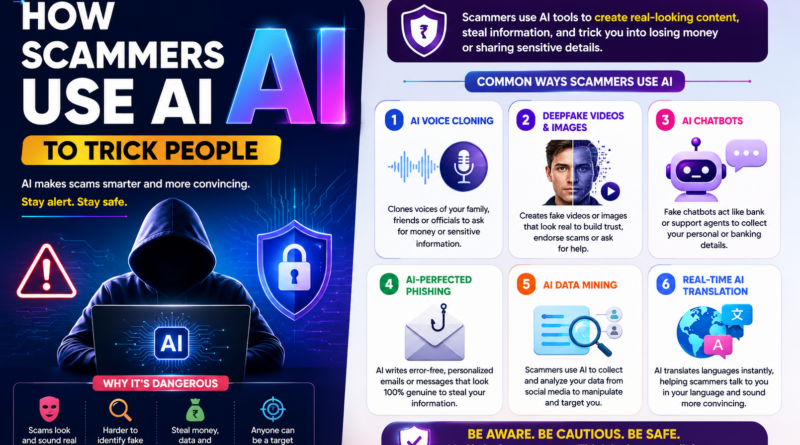
How Scammers Use AI to Trick People: New Online Scam Tactics to Watch
Artificial intelligence (AI) has changed the way people work, communicate, create content, and use technology. AI tools can generate realistic text, images, voices, and videos within seconds. While these technologies have many useful applications, scammers are also using AI to make online fraud more convincing.
Traditional scams often contain obvious spelling mistakes or suspicious messages. Modern AI-powered scams can look much more professional. A scammer may use AI to create convincing messages, imitate voices, generate fake images, or produce realistic videos.
Understanding how these scams work can help people recognize warning signs and protect themselves.

1. AI-Generated Phishing Messages
Phishing messages are designed to trick people into clicking a link, sharing information, or making a payment.
In the past, phishing emails were sometimes easy to recognize because they contained poor grammar and obvious mistakes. AI can now help scammers create polished messages that appear more professional.
A fake message may claim to come from:
- A bank
- A delivery company
- A government service
- An employer
- A shopping website
- A friend or family member
The message may create urgency and encourage you to act immediately.
Don’t trust a message simply because it looks professionally written.
2. AI Voice-Cloning Scams
AI can be used to imitate a person’s voice from audio samples.
A scammer may call someone and pretend to be a family member, friend, manager, or other trusted person.
The caller might claim that they are in an emergency and urgently need money.
If you receive an unexpected call involving money, don’t rely only on the voice.
Try to verify the person’s identity through another trusted communication method.
3. Fake AI-Generated Videos
AI technology can also create or manipulate videos.
Scammers may use fake videos of celebrities, business leaders, influencers, or other public figures to promote fraudulent investments, products, giveaways, or financial schemes.
A realistic-looking video is not proof that the person actually made the statement.
Before trusting an unusual financial or promotional claim, check the information through the person’s verified account or the organization’s official website.
4. Fake Job Offers
AI can help scammers create professional-looking job descriptions, emails, offer letters, and recruiter messages.
A fake recruiter may use AI-generated content to make a fraudulent job opportunity appear legitimate.
Warning signs include:
- Guaranteed employment
- Extremely high salaries
- No proper interview
- Requests for registration fees
- Requests for deposits
- Unverified recruiter accounts
- Pressure to act immediately
Never pay money simply because someone promises you a job.
5. AI-Powered Romance and Social Engineering Scams
Scammers can use AI to maintain conversations with victims and create convincing online identities.
They may use AI-generated profile pictures, messages, and personalized conversations to build trust.
After establishing a relationship, the scammer may ask for money, financial information, gift cards, or cryptocurrency.
Be careful when an online contact quickly develops into a financial request.
6. Fake Customer-Care Messages
Scammers can use AI to create convincing customer-support messages.
For example, you may receive a message claiming that your bank account, shopping order, mobile service, or payment has a problem.
The scammer may provide a fake customer-care number or suspicious link.
Don’t automatically trust customer-support information received through an unexpected message.
Find contact details through the company’s official website or application.
7. AI-Generated Fake Documents
AI can make it easier for scammers to create professional-looking documents.
Fake invoices, appointment letters, receipts, identity documents, and other materials may look convincing at first glance.
Never assume that a document is genuine simply because it contains logos, signatures, or official-looking formatting.
Verify important documents through the organization that supposedly issued them.
8. Fake Investment Opportunities
AI can make fraudulent investment advertisements appear more professional.
Scammers may create fake websites, promotional videos, charts, testimonials, and messages designed to convince people that an investment opportunity is legitimate.
Be particularly careful when someone promises:
- Guaranteed profits
- Very high returns
- No risk
- Quick money
- Exclusive investment opportunities
Always research financial opportunities independently before investing money.
9. How to Identify AI-Powered Scams
There is no single method that can identify every AI-generated scam.
Instead, look for behavioral warning signs.
Be cautious when someone:
- Creates extreme urgency
- Requests money unexpectedly
- Asks for OTPs or passwords
- Requests your UPI PIN
- Sends suspicious links
- Refuses independent verification
- Offers unrealistic rewards
- Uses fear or pressure
- Asks you to keep the conversation secret
These warning signs are more important than whether the message, voice, or video looks realistic.
10. Verify Before You Trust
If someone contacts you with an urgent request, take a moment to verify their identity.
For example, if someone claiming to be a family member asks for money, call them using a number you already know.
If someone claims to represent a bank or company, contact that organization using its official website or application.
Don’t use contact information supplied by the suspicious caller or message.
11. Never Share Sensitive Information
AI-generated scams can be designed to make you feel comfortable enough to reveal sensitive information.
Never share:
- OTPs
- UPI PINs
- Banking passwords
- Card PINs
- Internet-banking credentials
- Password-reset codes
Legitimate organizations generally have secure processes for handling account verification and transactions.
What Should You Do If You Fall for an AI Scam?
If you believe you have shared information or transferred money to a scammer, act quickly.
Contact your bank or payment provider through an official channel and report the transaction.
In India, suspected financial cyber fraud can also be reported through the official cybercrime reporting system or by calling 1930.
Save screenshots, messages, phone numbers, payment information, emails, and other evidence.
Conclusion
AI is making online scams more convincing, but the basic protection principles remain the same.
Don’t trust unexpected messages simply because they look professional. Don’t assume a familiar voice or realistic video proves someone’s identity. Always verify important requests independently.
Stop, think, and verify before sending money or sharing confidential information.
The more realistic a scam appears, the more important it is to slow down and check the facts.
AI can make a scam look convincing, but careful verification can help you stay one step ahead.