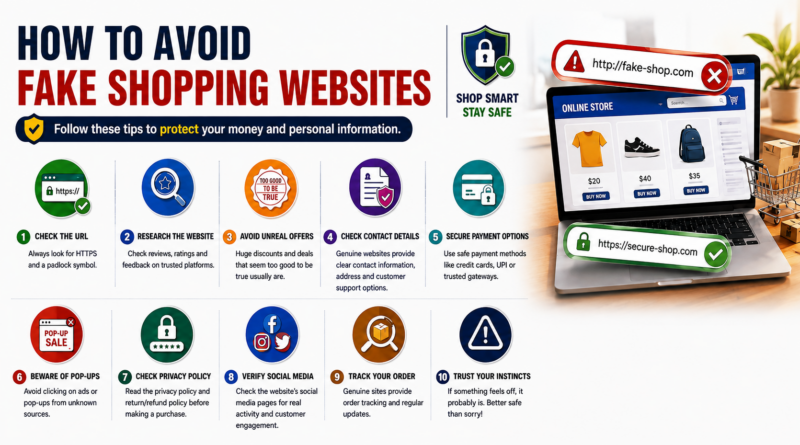
How to Avoid Fake Shopping Websites: 12 Simple Safety Tips
Online shopping has made it easier than ever to buy clothes, electronics, groceries, accessories, and other products from home. However, the growth of online shopping has also created opportunities for scammers to create fake shopping websites.
A fake shopping website may look similar to a genuine online store. It may offer expensive products at unusually low prices, display fake reviews, or use misleading offers to convince customers to make a payment.
If you know what warning signs to look for, you can reduce your chances of falling victim to an online shopping scam.
Here are some practical tips to help you identify and avoid fake shopping websites.

1. Check the Website Address Carefully
One of the first things you should check is the website’s URL.
Scammers may create websites with names that look similar to popular brands. They may change a letter, add extra words, or use a different domain.
For example, a fake website might use a domain name that looks almost identical to a legitimate store.
Always check the spelling of the website address before entering personal or payment information.
2. Look for HTTPS
Check whether the website uses HTTPS.
A secure connection usually displays a padlock symbol in the browser’s address bar.
However, remember that HTTPS alone does not prove that a website is legitimate. Scam websites can also use HTTPS.
Use it as one security check, not as proof that the website is genuine.
3. Be Careful With Extremely Low Prices
An unusually large discount should make you stop and investigate.
If a product normally costs ₹50,000 but an unfamiliar website is selling it for ₹10,000 with an “only today” offer, don’t immediately assume you’ve found a bargain.
Compare the price with established retailers and the brand’s official website.
If the difference is extremely large, there may be a reason.
4. Check the Company’s Contact Information
A legitimate online store should generally provide ways for customers to contact the business.
Look for:
- Company name
- Physical address
- Customer-support information
- Email address
- Return address
- Terms and conditions
- Privacy policy
Be cautious if the website has only a mobile number or a generic email address and provides no meaningful business information.
5. Read the Return and Refund Policy
Before placing an order, read the return, refund, cancellation, and replacement policies.
Pay attention to:
- Return period
- Refund conditions
- Shipping charges
- Replacement rules
- Refund processing method
A website that has vague or copied policies should be treated carefully.
6. Search for Independent Reviews
Don’t rely only on reviews displayed on the shopping website itself.
Search the store’s name online along with words such as:
“reviews”, “scam”, “complaints”, or “customer experience.”
Look for information from multiple independent sources.
Be careful if every review looks extremely positive, uses similar wording, or appears to have been posted around the same time.
7. Check the Website’s Age and Reputation
For an unfamiliar website, you can investigate its online presence.
A website that appeared very recently and is suddenly offering expensive products at huge discounts deserves extra caution.
You can also search for the company name and website address to see whether customers have reported problems.
8. Avoid Suspicious Links in Messages
Scammers often promote fake shopping websites through SMS, WhatsApp, email, social media, and online advertisements.
You may receive messages such as:
- “Your exclusive offer is expiring today!”
- “Claim your ₹5,000 shopping voucher.”
- “You’ve won a special reward.”
- “Complete payment to receive your parcel.”
Don’t click suspicious links simply because the offer sounds attractive.
Instead, type the known website address yourself or use the company’s official application.
9. Be Careful With Payment Methods
If an unfamiliar website insists on immediate payment through a personal UPI ID, direct bank transfer, or other difficult-to-reverse payment method, be cautious.
For unfamiliar sellers, check whether safer payment options are available.
Never share your UPI PIN, OTP, banking password, or card PIN with a seller.
10. Check for Fake Social Media Accounts
Some fake shopping websites have social media pages that appear professional.
Don’t assume that a large number of followers means the business is genuine.
Check the account history, customer comments, website information, and whether the business has a consistent online presence.
11. Don’t Trust Pressure Tactics
Scammers often try to make customers act quickly.
Messages such as:
“Only 2 minutes left!”
“Last chance!”
“Pay now or your order will be cancelled!”
are designed to prevent you from thinking carefully.
A genuine purchase should not require you to ignore basic safety checks.
Take your time and verify the seller before paying.
12. Keep Your Personal Information Private
Don’t provide more personal information than necessary.
Be particularly careful with requests for:
- Bank passwords
- UPI PIN
- OTP
- Card PIN
- Aadhaar details
- Unnecessary identity documents
A legitimate shopping transaction should not require you to reveal confidential banking credentials.
What Should You Do If You Think You Have Been Scammed?
If you have already made a payment to a suspicious website, act quickly.
Contact your bank or payment provider through an official channel and report the transaction.
If you believe you have experienced financial cyber fraud in India, you can also report it through the official cybercrime reporting system or call 1930.
Keep screenshots, transaction details, emails, messages, order information, and the website address as evidence.
Conclusion
Fake shopping websites can look surprisingly convincing, but there are usually warning signs if you know where to look.
Always check the website address, compare prices, investigate the seller, read return policies, look for independent reviews, and avoid suspicious links.
Most importantly, never share confidential banking information such as your UPI PIN, OTP, passwords, or card PIN.
When an online deal looks too good to be true, take a moment to verify it before making a payment. A few minutes of checking can save you from a major financial loss.